










How to Get High on Your Own Dopamine — The brain, behaviour, and the quiet return of momentum
31/03/2026
Moving Beyond Awareness of Autism: Masking, Misunderstanding, and the Myth of “Overdiagnosis”
12/04/2026
Surgery, Function, and the Brain
Week 5 Post-Op: The Return to Work, the Reality, and Rewriting “Pacing”
This is the sixth in a series of "Surgery, Function, and the Brain" blogs on Maria's recent surgical experience. Her previous blogs are:
- Starting This Journey
- 72 Hours Post-Op: Protection, Patience & “The Zipper”
- 96 Hours Post-Op: What Is This Thing Called Patience?.
- Day 7 Post-Op: When the Brain Starts Negotiating
- Day: 15 Post-Op: The Pacing Paradox
Week 5 post-op recovery is often where expectations and reality collide. On paper, you’re “back” — back at work, back in routine — but your body and brain are still negotiating capacity, symptoms, and limits in real time.
Five weeks in, and this is where things get interesting — not because everything is better, but because everything is revealing itself more clearly.
I returned to work at two weeks post-op. Sensible on paper: very part-time for a week, then back to full-time over the following three. In practice? A different story.
I started with the intention to pace. Structured breaks. Position changes. Lying down between clients.
That lasted… briefly.
What actually happened was this: I got pulled back into what I love — my clients. I found myself absorbed, engaged, focused… and completely forgetting to stand, stretch, or lie down. Session after session, I overrode the plan.
And yet — despite that — something shifted.
Day by day, I noticed:
- The uncomfortableness easing, not disappearing, but softening.
- Movement becoming more fluid, less guarded.
- Driving improving, both physically and in confidence.
Not linear. Not predictable. But undeniably moving forward.
The Meerkat Test
Then came what I now think of as a real-world functional milestone.
Our team outing to Gorge Wildlife Park — specifically, the Meerkat Fun Initiation for our new and newish team members.
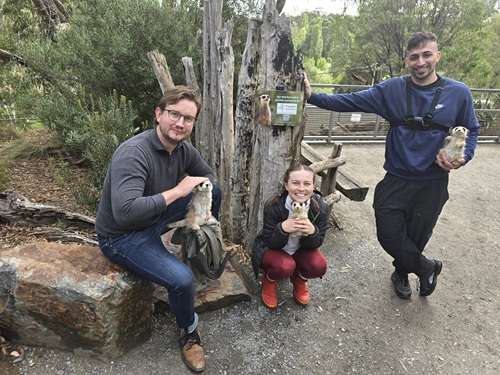

Tony was the director and producer, and I was one of the photographers (of course), but the real test wasn’t the camera — it was everything around it:
- Sitting as a passenger for over 30 minutes.
- Walking around the zoo.
- Transitioning between standing, moving, and sitting.
- Then actually sitting and enjoying lunch with the team.
Five weeks ago, that would have been unlikely. Or at least, costly in effort.
Now? Manageable. Not symptom-free — but functionally meaningful.
The Neurological Curveball
Here’s the part that would have rattled me before.
The neurological symptoms are still there. In fact — if I’m being honest — they’re worse than before surgery.
And this is where the real work is happening. Not in the body — but in the brain’s interpretation of the body.
Old pattern: “Something is wrong. This shouldn’t be happening. This means I’m not recovering.”
Current pattern: “It will take 6–12 months for these symptoms to improve… not 5 weeks.”
That distinction matters.
Because without it, the brain escalates: threat - vigilance - symptom amplification.
With it, the brain settles — not because the symptoms disappear, but because the meaning changes. This is active regulation. Not denial. Not blind optimism.
Cognitive containment of uncertainty.
Pacing (My Version)
Let’s talk about pacing — because I’ve had to completely reframe it.
What pacing should look like (in theory):
- Consistent activity-rest cycles.
- Pre-planned breaks.
- Stopping before escalation.
What pacing looks like for me:
- Getting it wrong… regularly.
- Overdoing it when engaged.
- Recovering, recalibrating, adjusting.
- Accepting variability without catastrophising.
I’ve had to accept something important: My pacing is not textbook pacing. And that’s okay. Because effective pacing isn’t about perfection — it’s about reducing boom-bust cycles over time, not eliminating them immediately.
The Unexpected Wins
Some things are quietly improving in ways that matter:
- Stairs — inside and outside — are no longer a major issue.
- General confidence in movement is increasing.
- My tolerance for being out in the world is expanding.
And then there are the meerkats.
Still cheering me on. Still slightly chaotic. Still a perfect reminder that progress doesn’t have to be serious to be meaningful.
Where Week 5 Leaves Me
Not “recovered.” Not symptom-free. Not perfectly paced.
But:
- Functionally improving.
- Neurologically challenged — but managed.
- More flexible in expectations.
- Less reactive to symptoms.
- More focused on trajectory than moment-to-moment fluctuations.
Week 5 isn’t about arrival. It’s about learning how to move forward without needing certainty. And that might be one of the most important shifts of all.
Week 5 post-op recovery is not a straight line — it is a recalibration. Returning to work brings progress, but also exposes the complexity of pacing, neurological symptoms, and cognitive habits. True recovery lies not in pushing harder, but in learning how to work with the brain, respect capacity, and rebuild function sustainably over time.
Two more blogs left! One after I see the Surgeon next week and then at the 12-month mark to check in and see if I have stuck to my exercise program.
The seventh in Maria's series of "Surgery, Function, and the Brain" blogs, on her recent surgical experience, is Week 6 Post-Op: Full Time, No Restrictions, and a Reality Check from the Surgeon.