












When Your Brain’s Smoke Alarm Won’t Switch Off
07/07/2026
Six Months Post-Op: I’ve Stopped Thinking About My Back
06/09/2026
Fear Avoidance and Chronic Pain
How Avoiding Pain Can Make It Worse
Fear avoidance can begin as a sensible attempt to protect yourself from pain, but over time it may become one of the factors keeping pain-related disability going.
What is Fear Avoidance?
If you're living with chronic pain, avoiding movement probably feels like common sense. It hurt last time, so why risk it again? If it hurts while moving that means I am doing damage…right? This instinct makes sense, but pain research shows that avoidance, while protective in the short term, often deepens pain and disability over time.
This is called the fear-avoidance model and understanding it can be a turning point in recovery.
How the Fear Avoidance Cycle Develops
The cycle usually starts with an injury or painful episode. From there, the pain might persist and we might begin to interpret the pain as threatening or catastrophic – “why isn’t it going away? Something is seriously wrong. Movement will only cause more pain”. This interpretation triggers pain catastrophizing, a pattern of thinking that magnifies the threat of pain and fuels anxiety around it.
That fear leads naturally to avoidance. Skipping activities, guarding the body, moving stiffly or cautiously. We begin to rely on behaviours and beliefs that feel protective. But how helpful are they?
How Avoidance Can Increase Pain and Disability
Over time, avoidance has costs: muscles decondition, joints stiffen, and the body becomes more sensitive rather than less. The person becomes more fearful of movement, more focused on the body, and function decreases. Even when the original tissue has healed, the fear-avoidance trap can remain.
Fear leads to avoidance, avoidance leads to disability, and disability reinforces fear. The cycle continues.
Hurt Does Not Always Mean Harm
Here's the key insight from modern pain science: hurt does not always mean harm.
In chronic pain, the nervous system can become sensitised, meaning it sends pain signals even when there's no ongoing tissue damage. Avoiding all activity in response to this pain doesn't protect the body, it often increases sensitivity, reduces function, and reinforces the belief that movement is dangerous.
This doesn't mean pain isn't real, or that people should "push through" recklessly. It means the relationship between pain and danger isn't as simple as it feels.
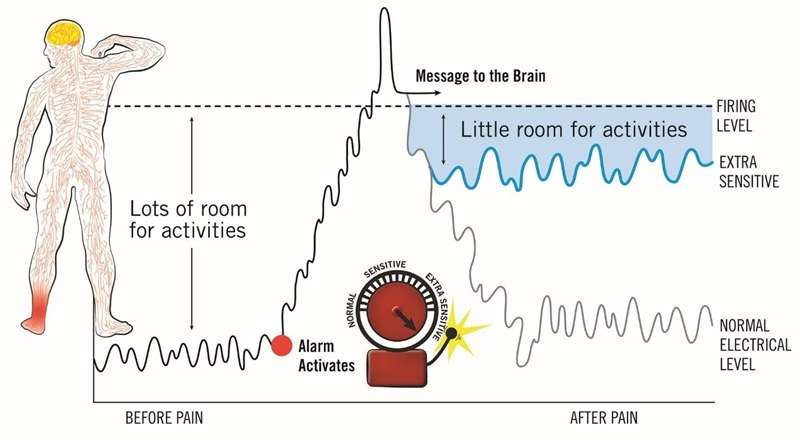
When the Nervous System Becomes More Protective
How to Break the Fear-Avoidance Cycle
Psychologists often address the fear-avoidance trap through graded exposure — a gradual, structured return to feared activities, starting small and building confidence over time. Pacing is key. This is paired with pain neuroscience education, which helps people understand what's actually happening in their nervous system, and cognitive strategies to identify and gently challenge catastrophic thinking patterns.
The goal isn't to eliminate fear overnight. It's to help the body and mind relearn, step by step, that movement can be safe, even in the presence of some discomfort. This then increases function and involvement in life.
You transition from a patient to being a person again!
Rebuilding Confidence in Movement
If you notice yourself avoiding more and more activities because of pain, you're not imagining the danger — you're responding to it the way your nervous system has learned to.
The encouraging news is that more adaptive patterns can be developed. With the right support, many people find that gradually facing feared movements, rather than avoiding them, is what ultimately restores both function and confidence.
If chronic pain is limiting your life, working with a psychologist alongside your medical care can help you address both the physical and psychological sides of recovery
A Practical Example of Graded Recovery
Imagine that walking for ten minutes has become frightening because a previous walk resulted in a pain flare-up. Complete avoidance may provide immediate relief from anxiety, but it can also reduce confidence and physical capacity over time.
A graded approach might begin with a shorter, manageable walk completed at a regular pace and repeated consistently. The starting point should be based on the person’s current capacity rather than on what they believe they “should” be able to do. As confidence and tolerance improve, the duration or difficulty can be increased gradually.
The aim is not to prove that pain is imaginary or to force the body through severe symptoms. It is to help the nervous system learn that carefully selected movement can be manageable and safe and then add to it. The program needs to be about increasing function rather than focused on reducing symptoms.

Key Takeaways
- Fear avoidance is an understandable protective response to pain but if it goes on too long, it becomes counterproductive.
- Pain during movement does not automatically establish that further tissue damage is occurring.
- Prolonged avoidance can contribute to reduced activity, confidence and function.
- Pacing is not the same as stopping all activity; it involves balancing activity and recovery in a planned way.
- Graded exposure helps a person return progressively to movements or activities that have become associated with danger.
- Recovery should be individualised and coordinated with appropriate healthcare professionals.
The goal is not simply to reduce pain, but to increase participation in a meaningful life.
Summary
Fear avoidance occurs when pain is interpreted as evidence that movement is dangerous, leading a person to restrict activity, guard the body or withdraw from important parts of life. Although this response may feel protective initially, prolonged avoidance can contribute to reduced conditioning, increased sensitivity, greater fear and worsening disability. Recovery does not involve ignoring pain or pushing through recklessly. It involves a gradual, individually paced return to meaningful activity, supported by appropriate medical care, pain education and psychological or rehabilitation strategies.
Want to Learn More?
Understanding the fear-avoidance cycle is an important first step. Changing the cycle usually involves building a series of safe and manageable experiences that help restore confidence in movement and everyday activity.
At Paragon PsychConnect, our psychologists help people living with persistent pain to:
- understand how pain, fear, stress and the nervous system interact;
- recognise patterns of avoidance and pain catastrophising;
- develop realistic pacing strategies;
- gradually return to feared or avoided activities;
- reconnect with work, relationships, recreation and other valued areas of life;
- we also believe that FUN is a therapy!
Our Compensable Persistent Pain Program uses an integrated psychological, neuroscience and rehabilitation approach to improve confidence, function and participation. Individual psychological support is also available. The program page currently outlines assessment, pain education, practical skill development, graded re-engagement and coordination with the person’s wider treatment team.
Take the Next Step
If you would like help with your chronic, or persistent, pain and overcoming your Fear Avoidance, register your interest in our Compensable Persistent Pain Group Program, or give Angela a call on (08) 7095 3484, or send us a message. You can also come and see a psychologist one on one.
Explore More Paragon PsychConnect Blogs about Pain
Read more mental health blogs about pain.
Explore Our Related Programs
Further Reading and References
- Chronic Pain Australia
https://chronicpainaustralia.org.au/
Provides accessible Australian information about chronic pain, assessment, treatment and returning to activity. - Noigroup Clinical Discussions
https://www.youtube.com/@NOIClinicalDiscussions/videos
Pain-management education and resources for clinicians and people living with chronic pain. - International Association for the Study of Pain – Behaviour Change Principles for Persistent Pain
https://www.iasp-pain.org/resources/fact-sheets/behaviour-change-principals-for-persistent-pain/
Discusses evidence-informed behaviour change and rehabilitation principles in persistent pain.
Disclaimer
This blog provides general information only and is not a substitute for individual psychological or medical advice.
Treatment should be individualised and coordinated with relevant medical and allied health professionals. New, unexplained or substantially worsening pain should be medically assessed before beginning a new activity program.