












Why Life Feels “Flat” for So Many People Right Now
13/05/2026
What Else Could This Mean? The Psychology of Assumptions, Anxiety and Cognitive Flexibility
12/06/2026
When Your Brain is Basically a Bengal Cat
Pain, Danger and Recovery
Pain and the brain have a far more complicated relationship than most people realise. Many people assume pain always means damage, but modern neuroscience has shown that pain is actually a protective output generated by the brain. Sometimes that protective system works brilliantly. Other times, it behaves more like a Bengal cat—independent, unpredictable, and occasionally convinced that ordinary situations are dangerous. Understanding how your brain creates pain can be the first step towards regaining confidence, function, and quality of life.
Many people with chronic pain wonder why they still hurt years after an injury has healed.
I was talking with a client recently about pain.
She asked me something that many people living with chronic pain quietly wonder: “How can you have back surgery and not have pain afterwards… but I still have back pain two years after injuring myself and I never even needed surgery?”
It is actually a very important question.
Because on the surface, it does not seem to make sense. Most people assume that more damage should equal more pain. But pain does not work that simply.
Why Pain Doesn't Always Mean Damage
I explained to her that the difference was not that I was “stronger” than her. And it certainly was not because her pain was not real. Her pain is absolutely real.
But she has chronic pain… and I don’t.
That matters.
I have worked in the pain space for more than 30 years. Over that time, I have learned something that fundamentally changes the way you recover after injury or surgery: The brain produces pain when it believes protection is needed.
Not because you are weak.
Not because you are imagining it.
And not because you are “crazy.”
Pain is a protective response.
After my back surgery, I expected soreness. I expected stiffness. I expected healing discomfort.
But I also consistently gave my brain one very important message: “You are safe.”
That does not mean I ignored symptoms. It means I did not interpret every sensation as danger.
I did not catastrophise every movement.
I did not become fearful of bending.
I did not constantly scan my body wondering if something had gone wrong.
My brain therefore had far less reason to keep producing ongoing protective pain.
My client looked confused.
“But I know I’m safe,” she said.
“I know,” I told her.
And this is where chronic pain becomes incredibly frustrating for people. Because danger processing in the brain is often not conscious. Consciously, people may fully understand that an injury has healed. But the nervous system can still remain sensitised and overprotective.
Can You Have Pain Without Injury? Yes. Modern neuroscience shows that pain is produced by the brain as a protective response. While injury can trigger pain, ongoing pain may continue after tissues have healed if the brain continues to perceive threat.
How Your Brain Learns Danger
The conscious part of the brain may say: “I’m okay.”
Meanwhile, deeper protective systems may still be asking: “What if you’re not?”
Those systems operate quickly, automatically, emotionally, and often outside awareness.
That is why people with chronic pain can genuinely know they are safe while their body still responds as though danger exists.
She then asked another really good question. “But why only sometimes? Some days I can lift heavy things and I’m completely fine. Other days I bend slightly wrong and my back flares up for no reason.”
That inconsistency confuses people enormously.
Because if the body was simply “damaged,” pain would usually behave more predictably.
Why Pain Comes and Goes
But chronic pain often fluctuates based on things like:
- stress
- fear
- fatigue
- poor sleep
- overload
- emotional distress
- hypervigilance
- previous experiences
- unpredictability
- perceived threat
The brain is constantly assessing safety and danger. Constantly predicting. Constantly deciding whether protection is required.
And sometimes… those decisions are not entirely logical.
My client works with animals and trains puppies, so I tried explaining it in a way that would make sense to her.
I told her: “Your brain is like a Bengal cat.” She laughed immediately.
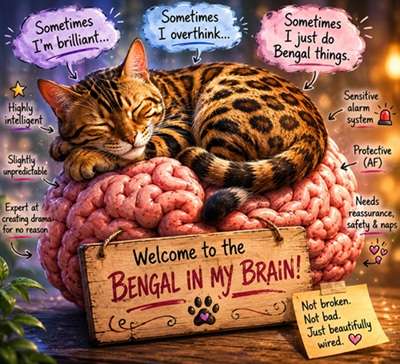
I continued.
“Sometimes Bengal cats just do things because… Bengal cat.”
“They knock over a vase that has been sitting untouched for six months.”
“Not because the vase changed.”
“Not because the cat needed to.”
“But because something in its chaotic little nervous system suddenly decided: ‘Today feels like a good day for destruction.’”
That is sometimes what a sensitised nervous system is like.
Not dangerous. Not broken. But unpredictable and overprotective. Sometimes the brain creates pain because it has learned to become highly reactive.
Sometimes it responds to stress.
Sometimes uncertainty.
Sometimes fear.
Sometimes memory.
Sometimes absolutely tiny changes you are not even consciously aware of.
And sometimes it just does what Bengal cats do.
Her eyes widened.
“Bloody hell,” she said. “Bengal???”
“No wonder it does what it wants sometimes…”
And honestly…that analogy clicked for her more than any neuroscience explanation I could have given. Because it removed shame from the experience.
People with chronic pain often become angry with themselves because symptoms fluctuate.
They think: “If I was okay yesterday, why am I struggling today?”.
But fluctuating symptoms are actually extremely common in sensitised nervous systems. The nervous system is not a machine. It is a living prediction system trying to keep you safe. Sometimes overenthusiastically.
Can You Retrain a Bengal Cat Brain?
But I finished the conversation by reminding her of something important. “Bengal cats are dramatic but even Bengal cats can be trained!”
That is the hopeful part. The brain changes. Neural pathways change. Protective responses change.
Not through force.
Not through ignoring pain.
And not through pretending symptoms are not real.
But through repetition.
What Helps Calm an Overprotective Brain?
Through gradually teaching the nervous system:
- “This movement is safe.”
- “This activity is safe.”
- “This sensation is safe.”
- “You are okay.”
That process takes time.
Especially when the nervous system has spent months or years learning protection.
But the brain is adaptable.
And with consistency, safety, movement, confidence, pacing, and reduced fear…even highly reactive nervous systems can begin to settle.
Even Bengal cats eventually stop attacking the vase.
Summary
Understanding pain and the brain changes the way we think about recovery. Pain is not simply a measure of tissue damage; it is your brain's best guess about how much protection you need at any given moment. Sometimes that system gets it right. Sometimes it behaves like a Bengal cat—reacting to invisible threats, changing its mind without warning, and keeping you on high alert. The good news is that the brain can learn. Through education, graded activity, confidence-building, and repeated experiences of safety, many people can reduce pain, regain function, and teach their Bengal cat brain that it no longer needs to sound the alarm.
Action
If you would like help with training the Bengal in your Brain, give Angela a call on (08) 7095 3484, or send us a message, and come and see us at Paragon PsychConnect.
You can see a psychologist for an individual appointment, or you can register your interest in our Pain Therapy Programs or check out chronicpainaustralia.org.au .
Explore More Chronic Pain Blogs
Looking for more insights? Explore our other Paragon PsychConnect Chronic Pain Blogs, including Maria's Back Surgery Blog series, which provides a firsthand account of her surgery, rehabilitation, and recovery journey.
Explore More Maria Blogs
Read more mental health blogs by Maria at Paragon PsychConnect.