











When Your Brain is Basically a Bengal Cat
31/05/2026
My Journey into Art: Discovering My Creative Voice – Reflections on Inspiration and Early Influences
12/06/2026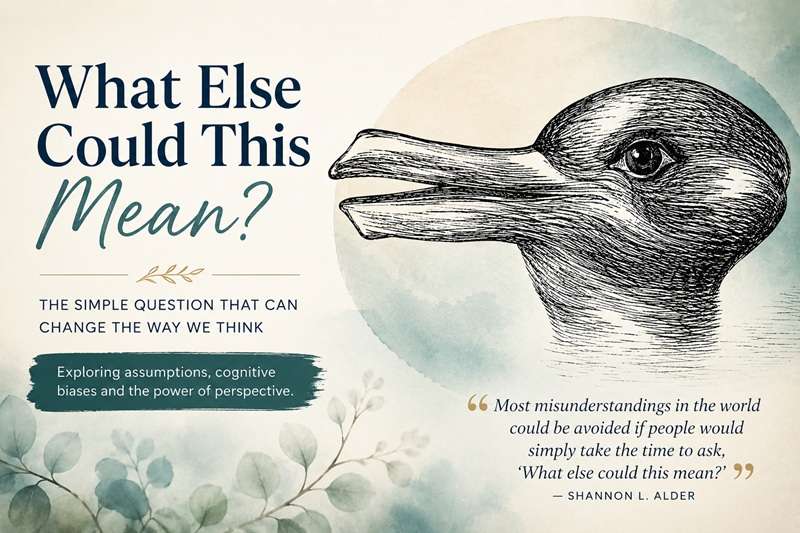
What Else Could This Mean?
The Psychology of Assumptions, Anxiety and Cognitive Flexibility
One of the most powerful questions we can ask ourselves is: "What else could this mean?" This simple question lies at the heart of cognitive flexibility, a psychological skill that helps us challenge assumptions, reduce anxiety, and respond more effectively to life's uncertainties. Whether we're interpreting a text message, navigating conflict in a relationship, or worrying about a future event, our brains often jump to conclusions. Learning to pause and consider alternative explanations can dramatically improve emotional wellbeing and decision-making.
The Simple Question That Can Change the Way We Think.
"Most misunderstandings in the world could be avoided if people would simply take the time to ask, 'What else could this mean?'" Shannon L. Alder.
I came across this quote recently and immediately thought, "That might be one of the most powerful questions we can ask ourselves."
As psychologists, we spend a lot of time helping people understand their emotions, behaviours, and relationships. Yet many of the difficulties people experience can often be traced back to something surprisingly simple: the meaning we attach to events.
Not the event itself. The meaning!
A friend doesn't return a text message. A colleague walks past without saying hello. A partner seems quieter than usual. A family member declines an invitation.
Within seconds, our minds can begin creating explanations.
- "They're angry with me."
- "I've done something wrong."
- "They don't care."
- "They are rejecting me."
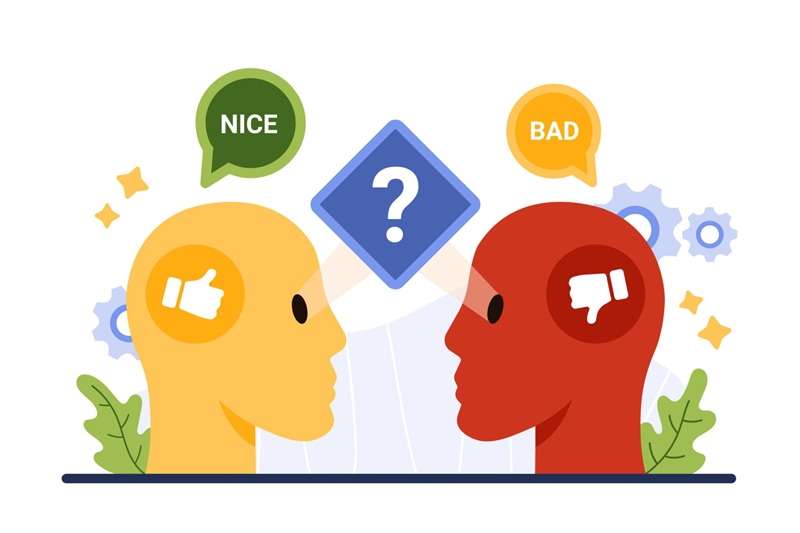
The remarkable thing is that we often accept these explanations as facts without ever stopping to ask whether there might be another possibility.
Our Minds Are Built to Fill in the Gaps
Human beings are natural meaning-makers. We are constantly interpreting the world around us and trying to make sense of what is happening. This ability serves us well much of the time. It helps us solve problems, predict outcomes, and navigate complex social situations.
The problem is that our brains do not particularly enjoy uncertainty.
When information is incomplete, our minds often rush to fill the gaps. Unfortunately, the explanations we generate are not always accurate.
They are often influenced by our emotional state, past experiences, fears, and assumptions.
- If we are feeling anxious, we may assume danger.
- If we are feeling depressed, we may assume hopelessness.
- If we have experienced rejection in the past, we may assume rejection again.
Before we know it, we are responding not to what has actually happened, but to the story our mind has created about what has happened.
Feelings Are Powerful, But They Are Not Always Facts
One of the biggest misconceptions about emotions is that they always arise from conscious thoughts.
In reality, many emotional reactions occur automatically and outside our awareness. We may experience anxiety, shame, anger, fear, or sadness without being fully conscious of the beliefs driving those emotions.
People often tell me:
- "I don't know why I'm upset."
- "I just have a bad feeling."
- "Something doesn't feel right."
When we explore these feelings more deeply, we frequently discover hidden assumptions operating beneath the surface.
Sometimes the underlying belief is:
- "I'm not good enough."
- "People will leave me."
- "I'm not safe."
- "Something bad is about to happen."
These assumptions may have developed years earlier and become so familiar that they feel like reality.
One of the most useful questions we can ask in therapy is: "If that feeling could speak, what would it be saying?"
Often, the answer provides valuable insight into the beliefs shaping a person's reactions.
The Trap of Mind Reading
One of the most common thinking traps psychologists encounter is known as mind reading.
Mind reading occurs when we assume we know what another person is thinking, despite having little or no evidence. Most of us have done it.
- A friend cancels plans.
- A colleague appears distracted.
- A partner seems quiet.
Our mind immediately generates an explanation and, more often than not, it tends to be negative.
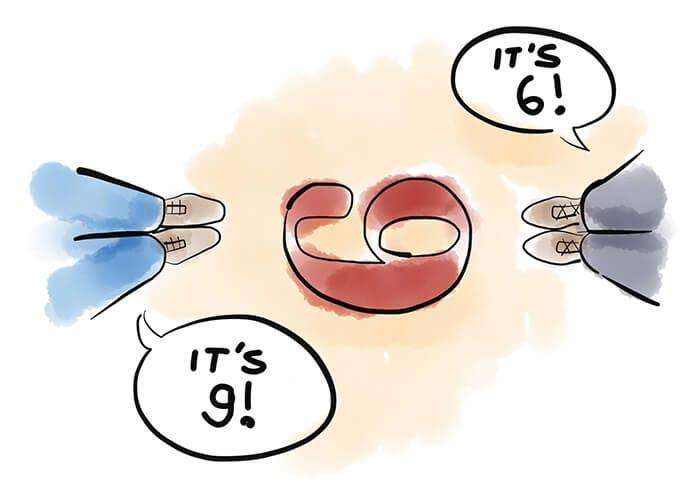
Yet there are usually countless other possibilities.
- Perhaps the person is tired.
- Perhaps they are stressed.
- Perhaps they are dealing with a family issue.
- Perhaps they simply had a busy day.
The reality is that we often know far less than we think we do.
Learning to Ask Better Questions
One of the goals of cognitive restructuring is not to force positive thinking or convince ourselves that everything is fine.
Instead, it helps us become more curious about our assumptions.
Rather than immediately accepting the first explanation that comes to mind, we learn to ask questions such as:
- What evidence supports this belief?
- Is there another explanation?
- Am I treating a fear as though it is a fact?
- What information might I be missing?
- What else could this mean?
These questions create space between an event and our interpretation of it.
That space is often where change begins.
Learning to Tolerate Uncertainty
Many people find uncertainty uncomfortable. In fact, some of us would rather have a negative answer than no answer at all. At least a negative explanation feels certain.
Unfortunately, certainty is not the same thing as accuracy.
Part of psychological growth involves learning to tolerate not knowing.
Instead of rushing to fill every gap with a worst-case scenario, we can practise holding multiple possibilities in mind until more information becomes available.
This can feel uncomfortable initially, but it often leads to better decisions, healthier relationships, and significantly less emotional distress.
Building More Flexible Thinking
Developing flexible thinking is a skill that takes time and practice. It involves learning to notice our automatic assumptions, challenge our thinking patterns, and consider alternative perspectives.
The goal is not to eliminate emotions or analyse every thought we have. Rather, it is to become more aware of how our minds work and to develop greater choice in how we respond to life's challenges.
When we become aware of the assumptions driving our reactions, we gain the ability to step back, reflect, and respond more intentionally. Over time, people often find they become less trapped by automatic emotional reactions and more able to approach situations with balance, perspective, and self-compassion.
A Question Worth Remembering
The next time you find yourself upset, worried, angry, or hurt, pause for a moment before accepting the first explanation your mind provides.
Ask yourself: "What else could this mean?"
It is a simple question. Yet it has the power to improve relationships, reduce anxiety, challenge assumptions, and create greater psychological flexibility.
Sometimes the situation does not need to change. Sometimes it is our interpretation of the situation that makes all the difference.
At Paragon PsychConnect, we help people understand the assumptions, beliefs, and emotional patterns that influence their wellbeing. Greater awareness creates greater choice, and greater choice creates lasting change.
Summary
At its core, cognitive flexibility helps us move beyond automatic assumptions and recognise that our first interpretation is not always the most accurate one. By learning to ask, "What else could this mean?", we can reduce anxiety, improve relationships, challenge cognitive distortions, and develop greater emotional resilience. Sometimes the most powerful psychological shift comes not from finding the right answer, but from becoming open to more than one possibility.
Action
If you would like help with developing flexible thinking, give Angela a call on (08) 7095 3484, or send us a message, and come and see a psychologist at Paragon PsychConnect.
Explore More ADHD Blogs
Looking for more insights? Explore our other Paragon PsychConnect ADHD Blogs.
Or watch our ADHD - Brains That Bounce Podcast.
Explore More Maria Blogs
Read more mental health blogs by Maria at Paragon PsychConnect.
References
Shannon L. Alder's quote "Most misunderstandings in the world could be avoided if people would simply take the time to ask, 'What else could this mean?'" can be found in her popular compilation book, The Narcissistic Abuse Recovery Bible: Spiritual Recovery from Narcissistic and Emotional Abuse.